Side profile of a bearded man wearing a faded dark blue baseball cap and a matching dark T-shirt against a plain light gray background.

Why your house is so dusty in Aberdeen, SD

Duct and vent cleaningDucts or ventsBrown County, SD
Step 1 of 2

What ZIP code is the job in?

Your house is dusty because your furnace runs for months at a stretch through an Aberdeen winter, and every one of those hours pushes air through the same ducts and the same filter. A thin or clogged filter lets dust through instead of catching it, and the duct runs themselves collect a layer that gets stirred loose and blown back into your rooms every time the blower kicks on. Dry winter air makes it worse: it carries dust more easily than humid air does, and it also dries out skin and wood, which adds more dust to what's already circulating. Furniture and floors won't stay clean long between cleanings when the system feeds dust back into the air all winter. The fix isn't just wiping surfaces more often. It's getting the ducts and the system itself cleaned out, so the air moving through your house isn't carrying months of buildup with it.

A smiling man in a green long-sleeve shirt stands at a dark kitchen counter with a ceramic mug, with wood cabinets, white tile backsplash, and a window and dining table behind him.
A smiling man with wavy dark hair and a beard, wearing a navy sweater, sits at a kitchen counter with a gray mug, with a dining table, potted plant and windows behind him.
A bearded man in a dark green sweater smiles and looks to his right while seated at a white kitchen counter with a gray mug, with windows and greenery behind him.
A smiling man in a dark navy sweater stands in a home interior beside a counter with a white mug, with a kitchen, hallway and potted plant in the background.

What's pushing all this dust through your house?

  • Half the homes here were built by 1973

    Half the homes in Brown County were built in 1973 or earlier. Older ductwork tends to leak at the seams, and that pulls attic or crawlspace dust straight into the air it moves.

  • Heat runs September through May

    Heat runs September through May here, nine months of the year. That's nine months of air cycling through your ducts and filter, over and over, before it ever lets up.

  • Cooling runs June through August

    Cooling only runs June through August. Those three months give your duct system its one real break of the year, and dust gets the rest.

ACS 2020-2024 · NOAA nClimDiv 1991-2020

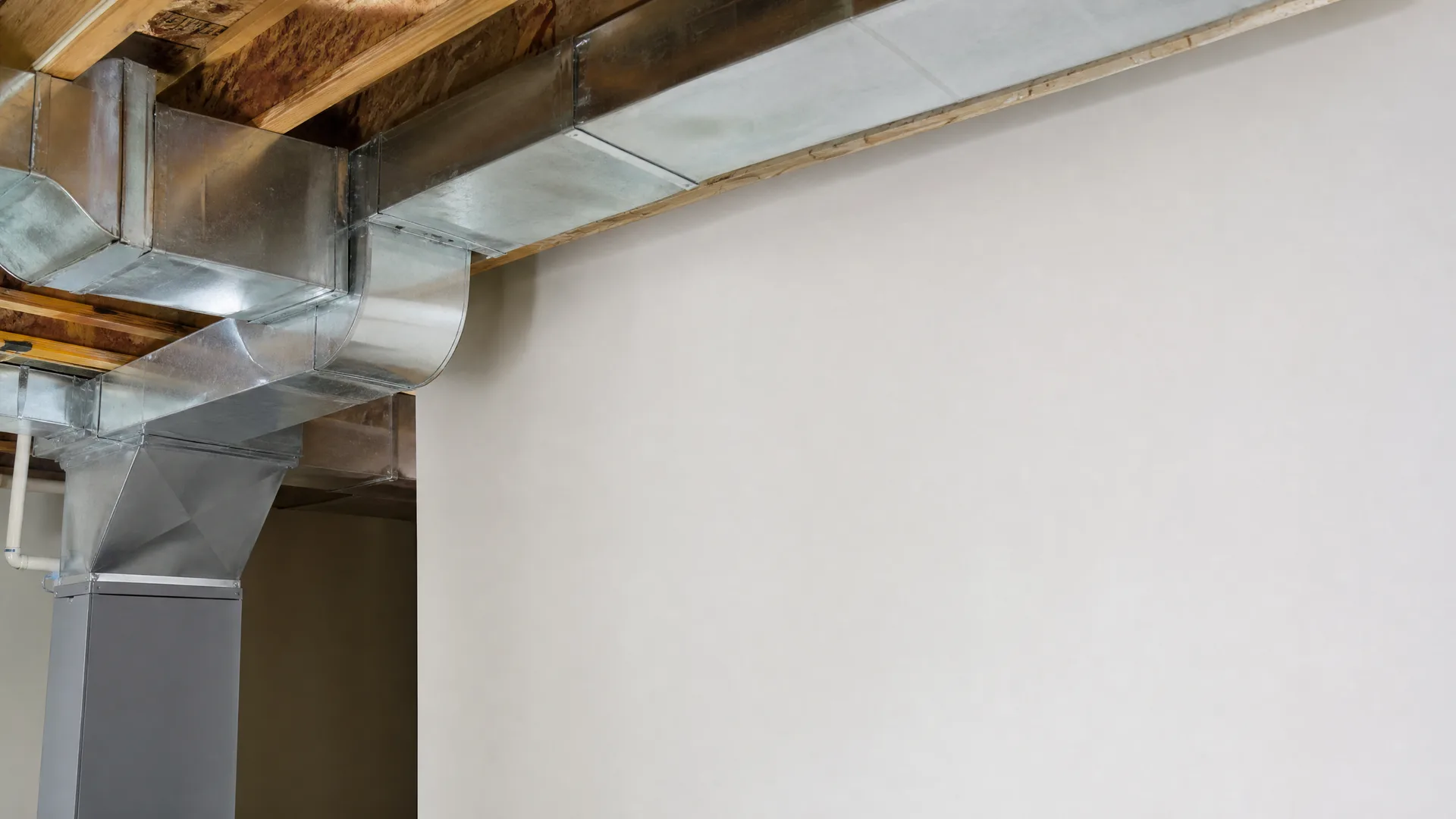
Galvanized sheet-metal HVAC ducts running along wooden joists at a basement ceiling, next to a plain off-white wall.

Running the furnace longer

A Brown County winter means the furnace cycles on and off for months without a break. Every cycle pushes air through the same ducts, past the same filter, into every room. The longer that runs, the more dust gets carried along with the heat, and the more it settles on your furniture and floors between cleanings.

Unfinished basement interior with galvanized sheet-metal HVAC ductwork and round pipes running along a wooden joist ceiling, a furnace and water heater at the far end, and a blank white wall filling the left half of the frame.

Running it on a schedule

A duct system that gets cleaned on a regular basis isn't moving years of buildup every time the furnace kicks on. Dust, pet hair, and whatever settled into the ductwork over past seasons gets pulled out instead of circulated through your house all winter. The air moving through your vents stays closer to what came out of the furnace, not what collected behind the walls.

Why does dust come back a few days after you clean?

You run a cloth over the end table, and by the weekend there's a film on it again. You see it settle on the TV screen first, then the windowsills. Furniture and floors near the vents collect it faster than anywhere else in the room. Some mornings you notice it in the light coming through the blinds, just hanging in the air before it lands. If anyone in the house has allergies or asthma, this is usually when it flares up, since the same air carrying the dust is what they're breathing all night. A duct system that keeps resupplying dust this fast usually has more built up inside it than a rag and a vacuum can reach.

Unfinished basement with bare concrete floor and walls, exposed wood joists, metal ductwork, a furnace unit, steel support posts, and a small window.

Ducts sealed tight

This is what duct runs look like when they're doing their job. Air moves from the furnace through closed metal, out the vents, and back again. Nothing from the basement or the space above the ceiling joists gets pulled in along the way.

Empty basement with bare concrete walls and floor beneath an exposed wood-joist ceiling carrying galvanized sheet-metal ductwork, round ducts and pipes.

Ducts pulling in dust

A gap at a joint or a seam that's come loose works like an open door. Every time the furnace runs, it draws in whatever's sitting in that unfinished space and sends it out through the vents with the heated air.

Why does dust come out of the vents when the furnace kicks on?

You walk past a vent right when the furnace kicks on and feel a puff of air carrying visible dust with it. It settles on the floor near the register within a few feet. It happens at the start of almost every cycle, not just once in a while, and you want to know if that's normal or a sign something in the system needs attention.

That's dust sitting in the duct getting pushed loose

Dust settles inside the duct between cycles, same as it settles on a shelf. When the blower starts, that first rush of air picks up whatever collected on the duct walls since the last cycle and carries it out through the vent. Through a Brown County winter the furnace cycles on and off for months, so this happens dozens of times a day. If the ducts leak at a seam, attic or crawlspace dust gets pulled in and adds to what's riding along with the air. A thin or clogged filter doesn't stop any of it, since the filter catches dust in the return air, not what's already loose downstream in the supply ducts.

Unfinished basement with bare concrete walls and floor, exposed wood joists, and galvanized sheet-metal HVAC ductwork and pipes running across the ceiling.
Tight seams keep the duct run sealed, so air moving past the copper and PVC lines stays clean.
Basement ceiling with galvanized sheet-metal ductwork, wooden joists and subfloor, black and white pipes, above a concrete wall and floor.
A split seam at this junction pulls dust from the basement right into the air headed for your rooms.
A dim room corner with a dark grey sofa and cushion, a wooden side table holding a ceramic vase and a small potted plant, a linen curtain beside a bright window, and a wall vent near the ceiling.

It's April, and the sun through the living room window is strong enough now to show what the lamp light never did. You're on the couch and you notice the ceiling vent first, a gray line of dust caked along the grille. Your eyes drop to the end table below it, the one you wiped down just last week, and there's already a dull coat sitting on the wood. The TV screen has it too, a soft haze across the black. You run a finger along the table edge and it comes back gray. The furnace isn't even running much anymore, but the dust it pushed around all winter is still settling, room by room, exactly where the vents point.


Let someone else find the pro

You've wiped the same shelf three times this month and it still comes back gray. Figuring out which part of the duct system is letting dust through isn't a weekend project. It means getting under the house or into the attic, checking seams joint by joint, and knowing what a bad connection looks like versus a normal one. Most people don't have the time for that between work and everything else a house in Brown County demands once the furnace is running every day. A contractor who cleans ducts for a living can look at your system and tell you in minutes what would take you an afternoon of guessing to find, if you found it at all. Send the request once, and you're done calling around and explaining the same thing to three different companies. The dust on your windowsill this week came from somewhere specific in your house. Someone who does this work can find it.

How a leaky duct spreads dust

  • A leaky return duct pulls air from the basement or crawlspace before it ever reaches the filter.
  • Static pressure builds when a filter is clogged, and that pressure forces more air out through loose joints instead of through the grille.
  • Flex duct that sags or kinks slows airflow and lets dust settle inside the run instead of carrying it to the filter.
  • A supply duct leaking in an unconditioned attic or crawlspace draws insulation fibers and dust into the air stream.
  • Metal duct joints sealed with cloth tape years ago often dry out and separate, opening a gap at the seam.
  • The blower moves the same volume of air whether the ducts are sealed or not, so a leak just changes where that air comes from.

Every duct run is built to hold a seal from the furnace to the grille. When a joint opens up, the blower does not slow down or push any less air. It still has to move the same volume through the system, so it pulls that air from wherever it can get it, including the gap. If that gap sits in the basement, crawlspace or attic, the air stream picks up whatever is sitting in that space before it ever reaches a room. A clogged filter makes this worse. As the filter fills in, it gets harder for air to pass through it, and the static pressure in the duct climbs. That pressure looks for the easiest way out, and a loose seam is easier to push through than a dirty filter. Flex duct adds its own problem. Where it sags between joists or kinks around a tight turn, airflow slows down inside that section, and dust settles out along the inside of the duct instead of moving on to the filter where it belongs. Old metal duct joints show their age in the same way. Cloth tape was standard for sealing seams for years, and that tape dries out, shrinks and lets go at the edges over time. None of this shows up by looking at a vent. It shows up as dust that keeps coming back no matter how often the filter gets changed.

Power here costs 12.45 cents per kilowatt-hour

At 12.45 cents per kilowatt-hour, running the blower longer to chase dust around your house doesn't hit your bill the way it might elsewhere. The real cost is the leak in your ducts still feeding dust into every room, cycle after cycle.

EIA-861 2025

Empty basement room with bare concrete walls and floor, exposed wooden floor joists overhead, large galvanized sheet-metal ducts with a vent grille, colored pipes, and a single lit bulb.
Before you get your ductwork cleaning
Empty unfinished basement with bare concrete floor, insulated walls with vapor barrier between wood studs, exposed wood joists, galvanized sheet-metal ductwork, a recessed light, and a steel support column.
After you get your ductwork cleaning
Unfinished basement with bare concrete floor and walls, exposed wood joists, large galvanized sheet-metal ductwork, PVC and copper piping, and a gray furnace unit beside wood stud framing.

Duct run sealed

Metal runs stay joined tight across the ceiling joists, and the furnace moves air through them and back without pulling in anything else. The basement underneath stays exactly that, a basement, not a source feeding your vents.

Basement ceiling with large galvanized sheet-metal ductwork, round metal pipes and plumbing lines running beneath wood joists, above a bare concrete wall and floor.

Duct run leaking

A joint between the sheet metal and the pipes running alongside it has opened enough to draw in whatever sits in this basement. That water staining on the foundation wall points to damp air getting pulled in along with it, straight toward your registers.

A closed laptop and a ceramic mug of dark coffee sit on a wooden table, with a blurred kitchen counter, potted plant, wooden utensils and cutting boards, and a large window in the background.

Your ducts are telling you something

The dust in your house is coming from somewhere specific. A leaky seam, a split in a flex run, a filter that's been letting more through than it catches. That's been true every winter your furnace has run, and it'll keep being true until someone finds the actual leak and closes it up.

Finding that person is the part that takes the work out of your hands. No calling around Brown County asking who does duct cleaning, no explaining the gray film on your shelves three separate times to three separate companies, no sitting with quotes trying to guess which one actually checked the seams instead of guessing. You send the form once. The search for someone qualified stops being your problem.

A light gray sofa with gray and beige textured throw pillows and a cream knit blanket beside a white-framed window, with a small round side table holding a ceramic vase and potted greenery.
A bearded man in a dark t-shirt sits on a light sofa, smiling and looking down toward a laptop screen visible at the bottom edge of the frame, with a blurred living space behind him.
A bearded man in a plaid flannel shirt looks out a window at snow-covered conifer trees, with a steaming ceramic mug on the sill and wooden shelves holding dishes and a plant behind him.

One request and it's handed off

A duct cleaning won't stop a split seam from pulling in basement or attic dust, but it clears out what's already built up in the runs so your furnace isn't pushing it into every room this winter. Finding someone to check the ductwork joint by joint and run the cleaning usually means calling around, explaining the same problem more than once, then sorting through quotes. Send the form once and that part is done. You still get the dust addressed, without doing the legwork of finding who does it.

Fill out one form

Fill out one short form instead of calling around.

Asking costs nothing, and the choice to hire stays yours.