







Musty smell from vents in Aberdeen, SD

Send the request and finding a pro stops being your problem.

Send my request

A musty smell from your vents almost always means moisture sitting somewhere in the duct system, usually on the evaporator coil or in the ductwork itself, where dust and condensation together grow mold. Brown County summers aren't as heavy and humid as a lot of places, but any AC still pulls moisture out of the air as it cools your house, and that water has to drain away properly. If it doesn't, or if the coil stays damp between cycles, you get mold growth that smells musty every time air moves past it. It can also mean dust built up inside ducts that have been holding onto moisture, especially if a vent is near a bathroom or kitchen. Either way, the smell is a sign of something growing in a system meant to be moving clean air. It's worth having the ducts and coil looked at before the smell is the least of it.

Why does the musty smell keep coming back here?

  • Half the homes here were built by 1973

    Half the homes in Brown County were built in 1973 or earlier, and older duct runs give mold more seams and joints to settle into.

  • Heat runs September through May

    Heat runs September through May here, so warm, dry air moves through those same ducts most of the year and the smell rides along with it.

  • Cooling runs June through August

    Cooling only runs June through August, which is the short stretch when the coil stays wet enough for mold to take hold in the first place.

ACS 2020-2024 · NOAA nClimDiv 1991-2020

Where the smell actually starts

  • The evaporator coil sits wet after every cooling cycle, and dust pulled through the return settles into that moisture.
  • Mold needs that combination to grow: a surface that stays damp and dust or debris to feed on.
  • A sealed duct system has no way to dry out between cycles, so the coil and the drain pan nearby stay the main source.
  • The blower pushes air across the coil and through the ducts, carrying the smell into every room on that system.
  • A clogged or slow condensate drain lets water sit longer than it should, giving mold more time to take hold.
  • Dust buildup inside the ducts themselves gives mold something to grow on even after the coil is cleaned.

Your air conditioner pulls humidity out of the air by running it across a cold coil, and that coil stays wet long after the unit shuts off. Dust in the return air lands on that wet surface, and dust mixed with standing moisture is what mold needs to take hold. None of this happens out in the open where you'd notice it. It happens inside a sealed metal box with no light and no airflow once the system cycles off, which is exactly the kind of place mold grows best. Underneath the coil sits a drain pan and a condensate line meant to carry that moisture away. When the line is clogged or draining slowly, water sits in the pan longer than it should, and the problem gets worse instead of staying put. Once mold is established on the coil or in the pan, the blower does the rest of the work for it. Every time the system runs, that same blower pushes air across the coil and through the ductwork to reach your rooms, and it carries the smell along with it. Ducts themselves aren't immune either. Dust that settles inside the runs over time can hold onto mold even after the coil is cleaned, which is why the smell sometimes lingers until the ducts get attention too.

Dusty sheet-metal HVAC ducts with a rectangular vent register run beneath wooden floor joists above an empty concrete-walled basement.
Before you get your ductwork cleaning
Empty basement with bare concrete walls and floor, a small window at left, and exposed wood joists with galvanized sheet metal ductwork and pipes overhead.
After you get your ductwork cleaning

The smell itself is just the warning. What it tells you is that mold is already living in the system that moves air through every room of your house, and it rides along each time the furnace or AC kicks on. If anyone in the house deals with allergies or asthma, they are usually the first to notice something is off, even before the smell gets strong enough for everyone else to catch it. Pay attention to when the smell shows up. If it goes away with the system off and comes back once it's running, that points to the ductwork itself rather than just the coil. Left alone, it doesn't stay contained. Mold sitting in the ducts can work its way into insulation or framing nearby if nothing changes. Spraying an air freshener or swapping filters might cut the smell for a while, but none of that touches the moisture or the mold causing it. They're still sitting in the ducts, waiting for the next cycle to send spores through the house again.

What that smell is costing you

  • A musty smell that lingers tells you mold has had time to establish itself, not just a one-off damp spot.
  • Every time the furnace or AC cycles, air carrying mold spores moves through your living space and into rooms you breathe in all day.
  • People with allergies or asthma in the house tend to notice the air quality drop before anyone else does.
  • A smell that fades when the system is off and returns once it kicks back on points to the ductwork itself, not just the coil.
  • Mold sitting in the ducts can spread to nearby insulation or framing if it sits long enough without being addressed.
  • Masking the smell with sprays or filters treats the symptom while the moisture and mold stay exactly where they are.
A smiling man in a green ribbed sweater stands behind a wooden table holding a ceramic mug of coffee in a kitchen with white subway tile, shelves of potted plants, and a bowl of fruit.
A smiling man with dark curly hair and a beard, wearing a dark green knit sweater, stands at a white marble kitchen counter with a dark blue mug, with open shelving, pendant lights and a houseplant behind him.
A smiling bearded man in a green henley shirt stands at a kitchen island with a gray mug, looking off to the side, with a dining area and shelves blurred behind him.
A smiling man in a navy long-sleeve shirt sits at a wooden table in a kitchen and dining area, with a ceramic mug, a potted plant, and a sliding glass door behind him.

Send one request and you're done looking

Explain the job once and skip repeating it on every call.

There's no charge for the request.

Why the coil stays wet

Your air conditioner pulls moisture out of the air and that moisture collects on the evaporator coil as it runs. In a more humid climate that coil might stay wet for hours after each cycle. Brown County air is drier, so the coil doesn't stay damp as long as it would somewhere like Omaha or St. Louis. But dry doesn't mean dry enough. Dust moving through the return settles on that coil every time the system runs, and even a shorter damp period is enough time for mold to take hold once dust is sitting there. That's the combination a cleaning has to break, not just the moisture and not just the dust, but both at once.

Why sealed ducts trap the smell

Once mold is established on a coil or inside a duct run, there's no airflow path that lets it dry out and no sunlight reaching in to stop it. A duct system is built to move air, not to vent itself, so whatever takes hold in there stays until something physically removes it. That's why the smell doesn't fade on its own after a few dry days the way a damp towel might. The furnace runs September through May here, and each cycle moves air across the same contaminated surfaces again, which is why homeowners notice the smell coming back at the start of the next heating or cooling period rather than going away for good.

Power here costs 12.45 cents per kilowatt-hour

Cheap power at 12.45 cents a kilowatt-hour doesn't change what's growing in your ducts. Running the blower longer to chase that smell costs you little here, so there's no cost reason to put off a cleaning. The mold doesn't care what you pay for electricity either way.

EIA-861 2025

The smell comes from one spot

Sometimes the musty smell traces back to a single damp patch, usually the evaporator coil after a cooling cycle or a section of duct near an exterior wall. The rest of the system stays dry and the mold hasn't spread past where it started. A cleaning reaches that section, pulls out the growth, and the air moving through the rest of the ducts was never carrying spores in the first place. This is the easier case. It still needs a contractor to find the spot and clean it properly, but there's less ground to cover and the smell usually clears fast once that section is handled.


The smell has spread through the run

Other times the mold has had months to work its way along the duct run, especially in the older duct systems common around Brown County, where more seams and joints give it places to settle. Every register in the house is carrying some of it, not just the ones near the coil. A cleaning still fixes this, but it means the whole system gets worked, not one section, and the contractor needs to check return and supply sides both. The smell was never isolated to one room, which is usually the first sign you're in this situation rather than the first.

A smiling man with short dark curly hair and stubble, wearing a navy T-shirt, sits on a beige sofa looking down toward a dark object in the foreground, with a living room, round mirror, lamp and bright window behind him.
A man with graying hair and a beard in a plaid flannel shirt stands indoors looking out a frosted window at snow-covered trees, with a ceramic mug on the sill.
A closed laptop and a ceramic mug of coffee on a wooden table, with a blurred kitchen counter, cutting board, utensil jar and plant in the background.

What to do about the smell

A musty smell from your vents means mold somewhere in that duct system, most likely the evaporator coil, and it won't clean itself out. The dry air here won't fix it either. It takes someone going into the ducts and the coil and getting the moisture and the growth out, not just running the fan longer or swapping the filter.

Finding that person is the part you can skip. Instead of searching through a list of duct cleaners, calling a few, explaining the same smell and the same symptoms over and over, then sitting with quotes trying to tell them apart, you send one form. From there, finding someone to do the work is no longer something you have to manage yourself.

Interior corner of a room with a dark upholstered sofa and textured cushion, a potted plant, sheer curtains at a multi-pane window showing blurred green and yellow trees, and a dark table holding a wooden tray with stacked coasters and a small ceramic vase.
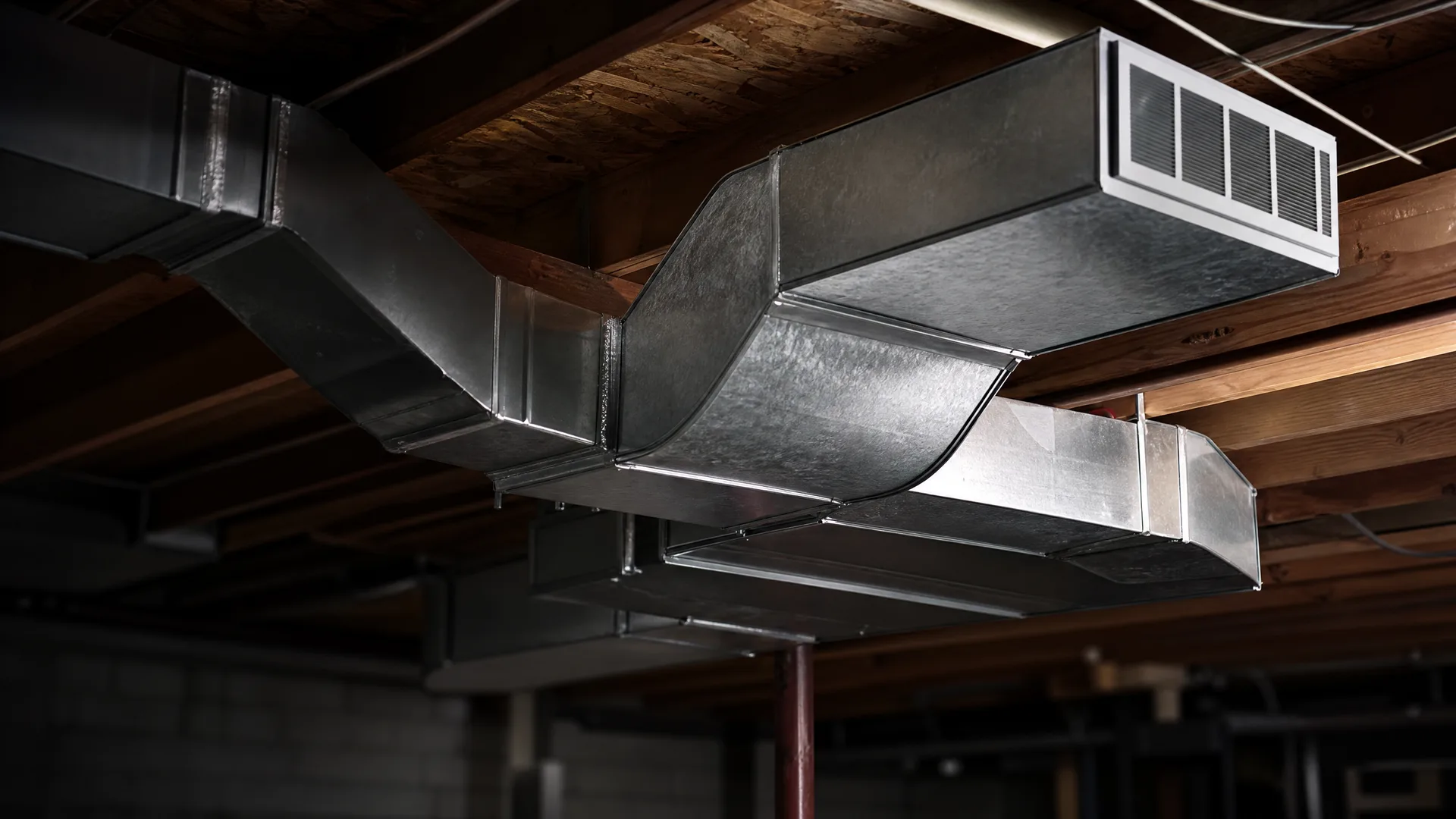
Galvanized sheet metal HVAC ductwork with a white vent grille, mounted against wooden floor joists in a dim basement with concrete block walls.

Finding a pro stops being your job

Duct and vent cleaningDucts or ventsBrown County, SD
Step 1 of 2

What ZIP code is the job in?