 Skip the calls
Mold in air ducts in Rapid City, SD
Answer a few questions about the duct cleaning and skip the search.
You noticed something off, maybe a musty smell when the furnace kicks on, maybe dust that keeps coming back no matter how often you clean. In Rapid City winters run long and hard, and a duct system that's shut up tight for months is a good place for mold to settle in, especially if there's been any moisture in the system from a condensation line or a humidifier.
Cleaning the ducts isn't a guess. A contractor has to get into the supply and return runs, check the coil and the drain pan where water tends to sit, and actually pull out what's growing in there rather than just spraying something and calling it done. That takes someone who does this work in Pennington County homes regularly and knows where it tends to show up first.
Finding that person is the part that eats your afternoon. You'd normally be searching for duct cleaning companies, reading through sites that all say the same thing, calling a few, explaining the smell and the symptoms again to each one, then waiting on quotes that are hard to compare because nobody inspected the same way. That's the part this page is built to skip.
Tell us what you're seeing, and you're connected with one licensed local contractor, not a list of five companies competing for your callback. Someone who works on duct systems around Rapid City through every one of these winters, who's seen what a gas furnace running from October to April does to ductwork over the years, and who can tell you on the spot whether what you're smelling is mold or something else entirely.
From there, the answer is below: what causes it, what it means for your air, and what the cleaning actually involves.
Can mold really grow in air ducts in Rapid City?
You keep catching a musty smell when the furnace kicks on, or you wipe down the same surfaces and the dust comes right back. It's easy to wonder if that's just an old house, or if something is actually growing where you can't see it. Mold needs moisture to take hold, and you're trying to figure out if your ducts could really have it, or if you're overthinking a smell.
Yes, if there's been moisture in the system
Mold needs moisture, and a duct system can hold onto it longer than you'd think. A clogged condensate line, a leaky duct joint, or even high humidity settling in the ductwork during a wet stretch gives mold what it needs to start. Once it's there, the dark, enclosed metal or flex duct keeps it fed as long as moisture keeps showing up. A musty smell when the furnace or AC first kicks on is one of the clearest signs, since that's the air moving across the growth before it clears out. Dust that returns fast after cleaning can mean the same thing, since mold spores and debris are circulating with every cycle the system runs.




Why ducts hold onto moisture
Mold needs moisture to grow, and ducts trap it in a few ways. Condensation forms on duct surfaces when humid air meets a cold metal line, especially near the AC coil in summer. In winter, a furnace that runs for hours at a stretch pushes air through ducts that may still hold moisture from a leak, a humidifier set too high, or a condensate line that isn't draining right. Dust and debris built up along duct walls give mold something to feed on once moisture is there. A duct system sealed up tight through a Rapid City winter doesn't get fresh air moving through it the way a room does, so any damp spot stays damp longer.
Where it usually takes hold
Mold in ductwork tends to start near the AC evaporator coil, where cool, wet surfaces sit right in the airstream, or in sections of duct that run through an unheated crawlspace or attic where temperature swings cause condensation. It can also show up around the furnace's heat exchanger if a vent isn't drafting properly. Once it takes hold in one section, spores travel with the airflow to registers throughout the house, which is why a smell near one vent can mean growth somewhere else entirely. A musty smell that's strongest right when the furnace or AC first kicks on is often a sign the source is close to the unit itself.
Why does duct mold show up more in some Rapid City homes than others?
Half the homes here were built by 1982
Half the homes in Pennington County were built in 1982 or earlier, and ductwork that old has had decades to collect the dust and rust that mold feeds on.
Heat runs September through May
Furnaces here run September through May, which means the ducts stay closed up and damp for most of the year before summer ever airs them out.
Cooling runs June through August
Air conditioning only runs June through August here, so any moisture the coil adds has just a few months to dry out before heat season seals the ducts again.
ACS 2020-2024 · NOAA nClimDiv 1991-2020
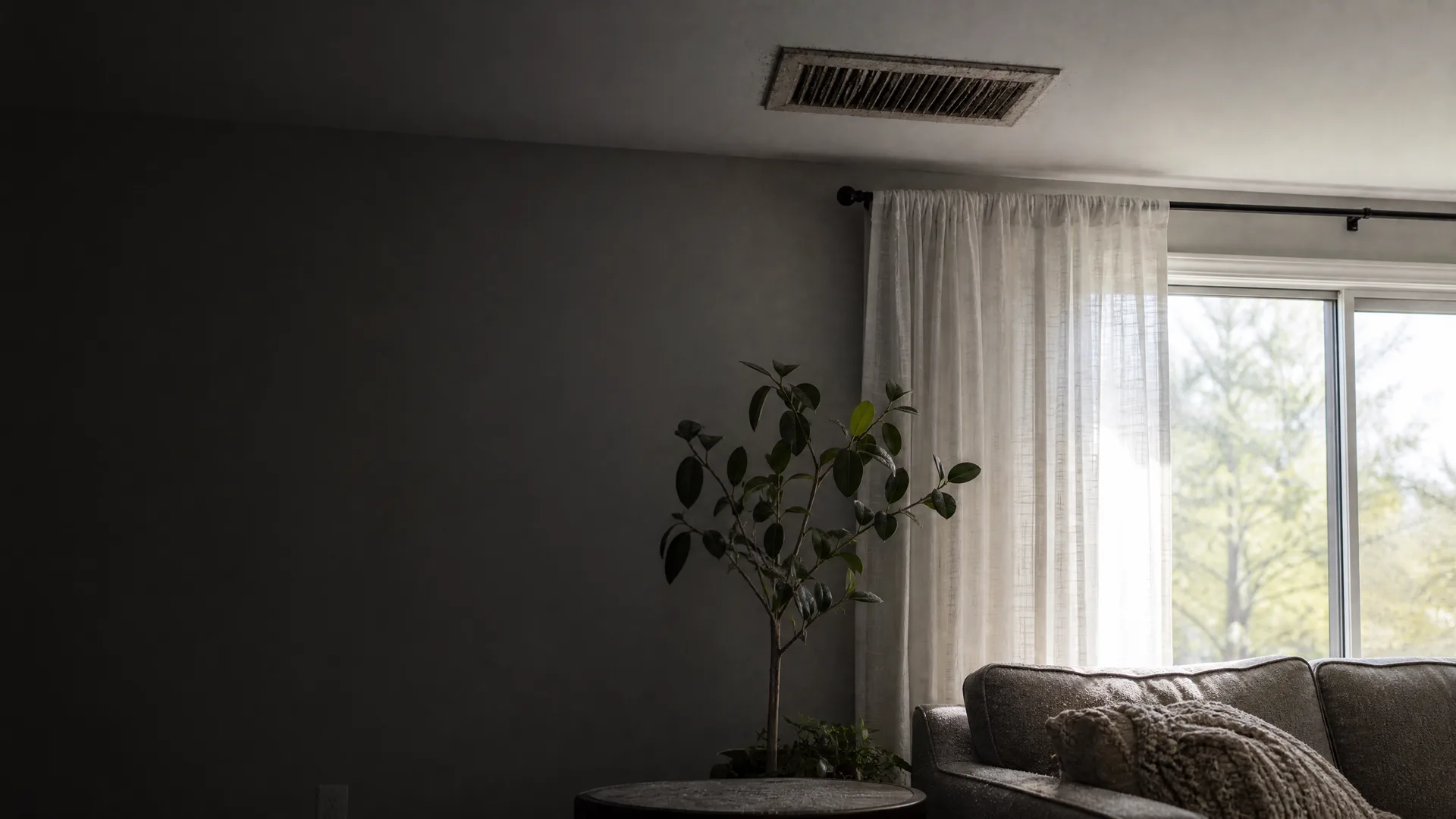
It's late April, and the furnace has finally gone quiet for the season. Sun comes in low through the living room window, the kind that shows everything. You're on the couch and happen to look up at the ceiling vent, and there it is, a gray ring of dust around the grille, thicker than you remembered. You run a finger along the coffee table underneath and it comes back coated. You just dusted this room three days ago. You stand there a second, looking from the vent to the table and back, doing the math on how many more times you're going to wipe this same spot down before you call someone who actually knows what's moving through that ductwork.
No calling every shop in Pennington County
You've read enough by now to know what's going on, or at least to want someone who can look at the ductwork and tell you for sure. Finding that person usually means searching around, calling a few places, explaining the musty smell and the dust and the gray ring around the vent more than once, then sitting with quotes that don't line up with each other. A contractor local to Pennington County who cleans ducts here deals with this same furnace cycle, the same AC coil condensation, the same older ductwork from homes built in the early 1980s or before. That's the kind of mold they're used to finding, not a guess. Handing this off means one call to make, not five, and no more wondering whether what you're smelling in March is worth worrying about. The furnace will run again come September. Whatever is sitting in those ducts now will still be there when it does.
How a contractor actually checks
- A duct inspection starts at the return side, since that's where household air and its moisture enter the system first.
- A contractor checks the AC coil and the drain pan closely, because standing water there is the most common source of duct mold.
- Flexible duct, the ribbed kind often run through attics or crawlspaces, holds moisture in its folds longer than smooth metal trunk lines.
- Mold on a vent cover doesn't confirm mold deeper in the duct run, so a camera or swab test is how a contractor checks further in.
- Cleaning alone won't fix regrowth if the moisture source, like a coil that sweats or a duct seam that leaks, isn't found and sealed.
- A contractor looks at the furnace's blower compartment too, since dust and moisture settle there as much as anywhere in the ductwork.
A real inspection follows the path moisture takes, not just the spots you can see from a stepladder. It starts at the return side, because that's where air from the house, along with whatever humidity it's carrying, first enters the system. From there a contractor moves to the AC coil and the drain pan underneath it. Standing water in that pan, or a drain line that's slow to clear, is behind more duct mold than anything else in the system. Flexible duct gets a closer look too. The ribbed kind, usually run through attics or crawlspaces, has folds that hold onto moisture far longer than a smooth metal trunk line would. A gray ring around a vent cover might be the only thing you've seen, but it doesn't tell you what's going on ten feet back in the run. That's why a contractor uses a camera or pulls a swab sample rather than guessing from the register. The blower compartment gets checked as well, since dust and condensation settle there just as easily as anywhere else in the ductwork. None of this matters much if the moisture source stays put. A coil that keeps sweating or a seam that keeps leaking will grow the same mold back, so finding that source and sealing it is part of the job, not an extra step after cleaning.


Mold doesn't need standing water to take hold inside a duct. It needs something to feed on, and the dust that coats duct walls over the years gives it exactly that. That's why a contractor doesn't just take your word for the smell. They'll usually swab the inside of the duct near the coil and have it tested, because mold and ordinary dust can look and smell similar from a distance. What happens next depends on where it's growing. Mold sitting on bare sheet metal often wipes right off. Mold that's worked into fiberglass duct liner or insulation is a different matter, since that material holds onto it, and that section typically gets replaced rather than cleaned. The cleaning itself is mechanical work, a brush or air whip run through each duct run to loosen what's built up, then a vacuum pulling it out through an access port cut into the system. Once it's back together, a well-sealed system should pull slightly negative pressure at the return, and the blower door and plenum get wiped down last, right before that air reaches your living room.
How a duct cleaning actually works
- Mold spores need a surface to feed on, not just moisture, so dust buildup on duct walls gives them something to grow into.
- A contractor usually swabs the inside of the duct near the coil and sends it for testing rather than guessing from smell alone.
- Mold on sheet metal often wipes off the surface, but mold inside fiberglass duct liner or insulation usually means that section gets replaced.
- Cleaning a duct system means running a brush or air whip through each run, then vacuuming the loosened debris out through an access port.
- A properly sealed duct system run after cleaning should pull a slight negative pressure at the return, which helps keep basement air from leaking back in.
- The blower door and plenum get wiped down last, since that's where cleaned air passes right before it reaches the living space.


Power here costs 15.09 cents per kilowatt-hour
At 15.09 cents per kilowatt-hour, running a fan or dehumidifier to dry out a damp duct run doesn't cost much to leave on. If a contractor suggests added ventilation near the coil to keep mold from coming back, that's not a bill you need to dread.
EIA-861 2025
A musty smell when the furnace kicks on, or dust that comes back no matter how often you clean, means it's worth having the ductwork looked at rather than guessed at. Moisture gets into ducts here through the AC coil, through a furnace that runs for hours on a cold night, through a basement run sitting against damp concrete. None of that tells you for certain there's mold without someone checking the coil, the drain pan, and the duct walls directly. What it does tell you is where to look first. A contractor working in Rapid City year round has seen what Pennington County ductwork usually runs into, old and new, and knows which spots to check before saying what's wrong. You'll be working with one local contractor who takes the call, not a handful competing for it. That's enough to get a straight answer about what's in your ducts and what, if anything, needs doing about it.
One form, no calling around