Mini Split Installation in Parker, SD
A new system here will heat from October through May and cool from June through August every year. Tell us about the house, and a licensed contractor who covers Turner County will get in touch.
Tell us about the job
It takes about a minute.
What a mini-split in Parker has to handle
Winter nights here average 12°F from December through February, and homes need heat from October through May. That is 8 months a year the heat pump side is doing the work, against nights well below freezing. Summer asks less, just 3 months of cooling with afternoons averaging 82°F. Between the two, a mini-split here runs 11 months out of 12.
Any new mini-split installed now has to meet the federal minimum for split-system heat pumps, 14.3 SEER2 for cooling and 7.5 HSPF2 for heating. That rating is measured in a lab. What it means on a night at 12°F, 8 months into a heating season, is what actually matters here.
- 8 months
- October through May, your system heats
- 3 months
- June through August, it cools
- 12°F
- the average winter night it heats against
- 82°F
- the average summer afternoon it cools against
NOAA nClimDiv, 1991–2020 normals
In South Dakota, HVAC licensing for homes is left to the cities and towns.
Turner County does not run its own contractor license, and South Dakota does not either. Whether any license applies to this job comes down to whether the nearest city or town requires one for HVAC work, and that rule does not reach out into the unincorporated parts of the county.
Installing a mini-split still means handling refrigerant lines and running electrical connections, and none of that is checked by a license here. What stands in for it is the permit process. In most cities and counties, an installation like this needs a permit from the local building office, with an inspection once the work is done, and that inspection is what checks the job was done right.
Source: South Dakota Legislature
- Is a mini split worth it?
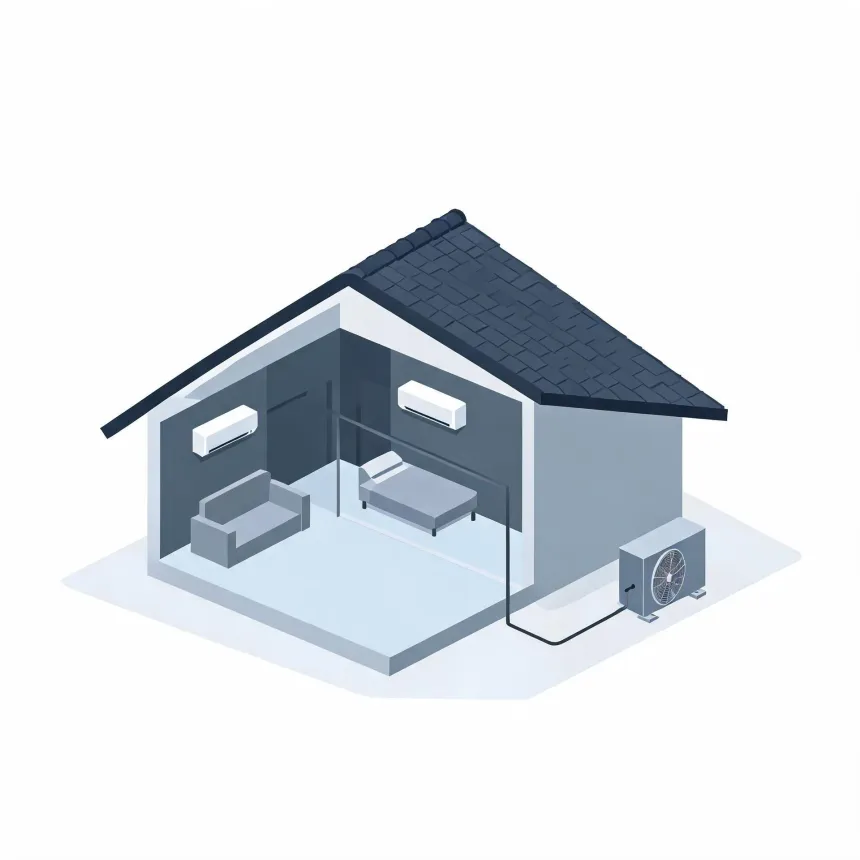
- For most homes, yes, especially if you're heating or cooling a room that isn't on the ducted system, or you don't have ducts at all. Parker needs heat eight months of the year and cooling three, so a mini split earns its keep by running through both seasons rather than sitting idle most of the year. Winter nights here average 12°F, and a cold-climate mini split will keep pulling heat at those temperatures instead of falling back on resistance heat alone. A contractor can look at your house and tell you whether a mini split makes more sense than extending ductwork or adding a window unit.
- How many rooms can a mini split cover?
- A single outdoor unit can run one indoor head or several, up to eight on some multi-zone systems. Each indoor head handles one room or open area, so the number of rooms you can cover comes down to how many heads the outdoor unit supports and how much capacity each room needs. A house with several rooms to condition usually needs a multi-zone system sized around those specific rooms, not one large head trying to cover everything. A contractor will size the system to your rooms, not the other way around.
- Can a mini split heat a whole house?
- It can, if it's sized and placed to cover every room, but that takes planning, not one indoor head in the living room doing all the work. Parker sees winter lows around 12°F, so any mini split expected to carry the whole house through those nights needs to be rated for cold climates and sized for that load, not just for a mild day. Every room you want heated needs its own indoor head, or a way to route air between rooms, since a mini split has no ductwork to spread heat on its own. A contractor can walk the house and say whether a mini split alone will carry it through winter or whether it's better paired with the existing heat source.